Weather Alert in Maryland
Winter Storm Warning issued February 5 at 1:17PM EST until February 7 at 7:00AM EST by NWS Baltimore MD/Washington DC
AREAS AFFECTED: Western Garrett; Eastern Garrett; Western Grant; Western Pendleton
DESCRIPTION: ...NEAR BLIZZARD CONDITIONS EXPECTED LATE FRIDAY NIGHT INTO EARLY SATURDAY... .A strong Arctic front will deliver heavy upslope snow showers and squalls, strong winds, and dangerously cold wind chills to the Alleghenies late Friday into the Saturday. * WHAT...Heavy snow expected. Total snow accumulations of 6 to 8 inches, with locally higher totals along western favored ridges (such as Backbone Mountain, Piney Mountain, and Keysers Ridge). Winds gusting as high as 50 to 60 mph that lead to significant blowing and drifting snow. * WHERE...In Maryland, Eastern Garrett and Western Garrett Counties. In West Virginia, Western Grant and Western Pendleton Counties. * WHEN...From 10 AM Friday to 7 AM EST Saturday. * IMPACTS...Roads, and especially bridges and overpasses, will likely become slick and hazardous. Visibilities may drop below 1/4 mile due to falling and blowing snow. Travel could be very difficult. The hazardous conditions could impact the Friday evening commute. Strong winds could cause tree damage. Travel could be treacherous and potentially life-threatening on I-68/US-40 west of Frostburg, MD, US-219 from the PA/MD Line south to WV Line, US-48 west of Moorefield, WV, and US-33/WV-28 west of Franklin, WV. * ADDITIONAL DETAILS...Expect roads to become impassable especially those in open areas due to blowing and drifting snow Friday night through Saturday. Wind chills will fall below zero Friday night with values as low as 20 to 30 degrees below zero from Saturday morning through Sunday morning. Frostbite and hypothermia can occur in these conditions in less than 30 minutes.
INSTRUCTION: Persons are urged to stay indoors until conditions improve. If you must go outside, dress in layers. Several layers of clothes will keep you warmer than a single heavy coat. Cover exposed skin to reduce your risk of frostbite or hypothermia. Gloves, a scarf, and a hat will keep you from losing your body heat. Persons should delay all travel if possible. If travel is absolutely necessary, drive with extreme caution and be prepared for sudden changes in visibility. Make sure your car is winterized and in good working order.
Want more detail? Get the Complete 7 Day and Night Detailed Forecast!
Current U.S. National Radar--Current
The Current National Weather Radar is shown below with a UTC Time (subtract 5 hours from UTC to get Eastern Time).

National Weather Forecast--Current
The Current National Weather Forecast and National Weather Map are shown below.

National Weather Forecast for Tomorrow
Tomorrow National Weather Forecast and Tomorrow National Weather Map are show below.

North America Water Vapor (Moisture)
This map shows recent moisture content over North America. Bright and colored areas show high moisture (ie, clouds); brown indicates very little moisture present; black indicates no moisture.

Weather Topic: What is Drizzle?
Home - Education - Precipitation - Drizzle
 Next Topic: Evaporation
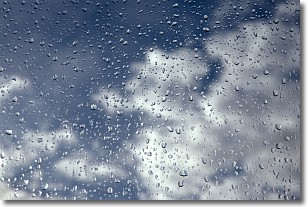
Drizzle is precipitation in the form of water droplets which are
smaller than raindrops.
Drizzle is characterized by fine, gently falling droplets and typically does not
impact human habitation in a negative way. The exception to this is freezing drizzle,
a condition where drizzle freezes immediately upon reaching earth's surface.
Freezing drizzle is still less dangerous than freezing rain, but can
potentially result in hazardous road conditions.
Next Topic: Evaporation
Weather Topic: What is Fog?
Home - Education - Cloud Types - Fog
 Next Topic: Fractus Clouds
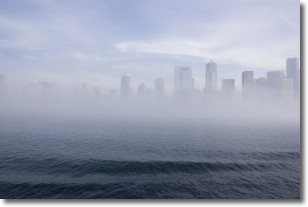
Fog is technically a type of stratus cloud, which lies along the
ground and obscures visibility.
It is usually created when humidity in the air condenses into tiny water droplets.
Because of this, some places are more prone to foggy weather, such as regions
close to a body of water.
Fog is similar to mist; both are the appearance of water droplets suspended in
the air, but fog is the term applied to the condition when visibility is less than 1 km.
Next Topic: Fractus Clouds
Current conditions powered by WeatherAPI.com